Louis's transformation
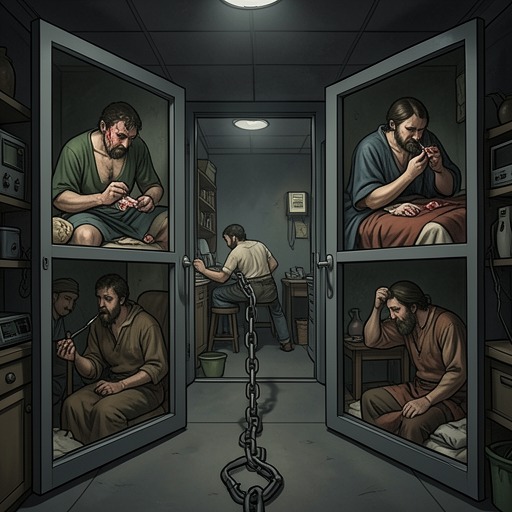
Interview with the VampireLouis's transformation is the central initiation through which Louis crosses from mortal despair into vampire existence. Lestat treats the conversion as both a practical bargain and a test of commitment: he wants Pointe du Lac plantation, needs Louis to manage the estate and protect his own blind father, and uses Louis's grief after his brother's death to make a new life seem possible. For Louis, however, the change is not a triumphant escape. It is a forced passage through murder, blood, bodily surrender, and the abandonment of the human world he has known.
Causes and Conditions
Louis reaches the threshold of transformation after his brother's death and the religious conflict that follows it. A priest interprets the brother's behavior through possession and the devil, while Louis comes to regard that explanation as a refusal to recognize either madness or sanctity. His rage culminates in violence against the priest, after which Louis is bled by those attempting to cure him. Weak, feverish, guilty, and convinced that he cannot continue living, he becomes vulnerable to Lestat's intervention. Lestat arrives at night at Pointe du Lac plantation, where Louis lies in bed while his sister sleeps nearby. The vampire's appearance immediately destroys Louis's egotism: his gray eyes burn with unnatural brilliance, and his long white hands reveal that he is not an ordinary man. Louis feels his former life shrink into insignificance before this extraordinary being and understands, through Lestat's promises, that another form of existence is possible. Lestat's motive is nevertheless mundane as well as supernatural. He wants the plantation and needs a mortal arrangement that will allow him to care for his blind father without exposing the truth.
The Conversion Ritual
The transformation begins with the death of the overseer. Lestat kills him in his sleep while Louis watches, making the act a condition of commitment. The overseer struggles, is drained over nearly an hour, and dies slowly in the narrow bedroom. Louis finds this the most difficult part because he has little fear of his own death but retains a profound regard for the lives of others. He is then forced to help dispose of the body, driving it along the river road and leaving it in open fields with its coat torn, its money stolen, and its lips stained with liquor so that the death will appear to be a robbery. Louis knows the overseer's wife and suffers over the fact that she will never understand what really happened. Afterward, Louis returns to the steps where his brother fell and begs Lestat to kill him. Lestat rejects the request as cowardice and refuses to let Louis's wish for death interrupt his own plan. He lies beside Louis, draws him against his chest, and explains that Louis's consciousness and will must keep him alive while he is drained. Lestat bites Louis's neck and reduces him within minutes to paralysis. The lamps in the upstairs parlor, the oil lantern on the gallery, and the shimmering light around the stairwell form the visual field of the passage, while the physical sensation combines panic, pain, and a pleasure Louis compares to passion. Lestat then bites his own wrist and orders Louis to drink. Louis obeys, experiencing the concentrated pleasure of nourishment as blood becomes the single point at which body and mind are joined. His perception changes before he can explain the process. Light fills his awareness, followed by two pounding rhythms: one is his own heart and the other is Lestat's. When Lestat pulls his wrist away, Louis instinctively reaches for it and forces it back to his mouth. The discovery that the second drum belongs to Lestat marks the first unmistakable recognition of his new sensory life.
Death of the Mortal Self
Louis does not identify one isolated instant as the entire conversion. He describes several acts, although the blood exchange creates the irreversible threshold. The change is therefore both physical and psychological: it requires witnessing a human death, participating in the concealment of a corpse, enduring the draining of his own blood, drinking from Lestat, and accepting a new dependence on the vampire who has engineered the passage. The final stage occurs at dawn. Louis refuses Lestat's demand that they share a bedroom for protection and instead carries his coffin down the brick stairs. He opens the oratory belonging to his dead brother, pushes through the roses and thorns that have nearly sealed it, and places the coffin before the prayer desk. Addressing his brother, Louis discovers that grief has not disappeared but has changed: for the first time he feels both nothing and everything for Paul's death, as though vampire existence has stripped away his former numbness and returned the sorrow in a more complete form. Louis then shuts the wooden blinds, bolts the door, climbs into the satin-lined coffin, and locks himself inside. This enclosure completes the transition. He is no longer merely a man who has received vampire blood or a fledgling dependent on Lestat's instruction; he has accepted the nocturnal, coffin-bound condition of a vampire. The last sunrise he remembers is the one he watches before leaving mortal life, with light passing through the French windows, falling across his sleeping sister, the shawl, the stone floor, and the water in the pitcher.
Immediate Consequences
The transformation does not produce the moral indifference Lestat expects. Lestat tells Louis that he will eventually laugh at death, but Louis insists that he never laughs at it, even though he becomes its frequent cause. His new body gives him speed, strength, heightened perception, and the capacity to kill, yet his consciousness remains organized around guilt and attention to the suffering of others. Immortality thus intensifies rather than resolves the contradiction that brought him to Lestat: Louis has escaped his own death only by becoming an agent of death. The new condition also binds Louis to Lestat. Louis distrusts and dislikes him, refuses to sleep in the same room, and sees him as frail and foolish after the conversion; nevertheless, he lacks the knowledge needed to survive independently. Lestat teaches him practical methods of vampire life, including the transportation of coffins by ship, the concealment of nocturnal travel, and the use of businesses and financial agents after hours. The relationship begins as coercive instruction but becomes the foundation of Louis's new existence.
Long-Term Significance
Louis's transformation governs the later course of his life. The new vampire searches for an origin and a community capable of explaining what he has become. He and Claudia travel through central Europe and the Carpathians, where they find mostly mindless revenants rather than conscious beings like themselves. Claudia studies old accounts describing the burning, staking, and beheading of vampires and plans a journey toward Varna and the Black Sea, hoping to discover the source of their kind. The contrast between Louis's reflective consciousness and the vacant creatures of eastern Europe makes his transformation appear exceptional, unstable, and ethically burdensome rather than simply biological. The event also shapes Louis's later movement through Paris and beyond. Paris overwhelms him with its beauty and historical grandeur, and at the Théâtre des Vampires he encounters a society that turns killing into spectacle. The theater's vampires perform Death before a human audience, using masks, music, painted scenery, and staged laughter to disguise an actual appetite for blood. That theatrical system exposes the social consequences of the transformation: what began for Louis as a private, traumatic passage can become an institution in which murder is aestheticized and normalized. Even after Louis leaves Paris with Armand, the consequences remain unresolved. He travels toward Egypt in search of ancient graves and further knowledge, later spends a long period in New York, and finally returns to New Orleans after learning that Lestat survived the theater's destruction. The return to New Orleans brings back the plantation, the old town house, and the atmosphere of the life he abandoned. Louis's transformation therefore never becomes a clean break. It remains an unfinished passage between mortal memory and vampire immortality, preserving the love, guilt, grief, and longing that the new body was supposed to replace.